Tap a fish: bait, rig, how to reel, and how long to waitTippe einen Fisch an: Köder, Montage, Kurbeln, Wartezeit
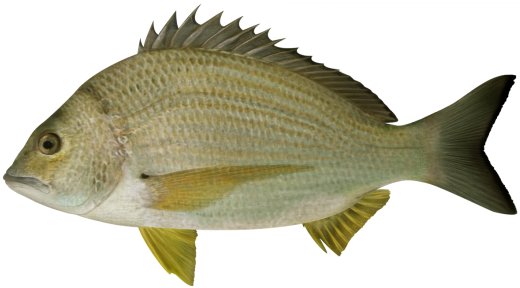
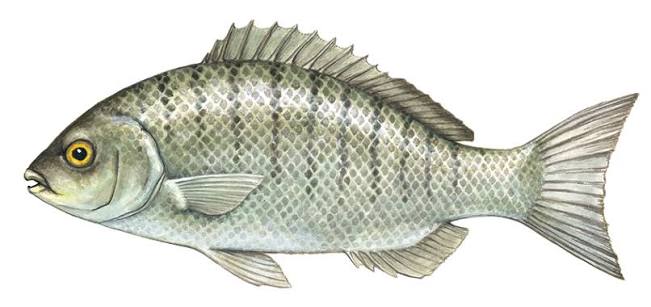
Yellowfin BreamAcanthopagrus australis
📍 WhereWo
All 3 spots — pontoons, bridge pylons, wall shadow linesAlle 3 Stellen — Pontons, Brückenpfeiler, Schattenlinien der Mauer
🪱 Bait & LuresKöder & Kunstköder
Peeled prawn or yabby (best). Also small soft plastics and prawn-imitation / hardbody lures. Backup: pipi, worm.Geschälte Garnele oder Yabby (am besten). Auch kleine Weichplastik- und garnelenimitierende / Hardbody-Köder. Ersatz: Pipi, Wurm.
MainlineHauptschnur6–10 lb braid
LeaderVorfach6–8 lb fluoro, 30–50 cm
HookHakenSize 1–2 octopus
Lead / sinkerBleiNo.0–No.1 ball running sinker, or noneLaufblei Kugel Nr.0–1, oder keins
KnotKnotenUni knot (hook); double uni (braid→leader)Uni-Knoten (Haken); Doppel-Uni (Geflecht→Vorfach)
🎣 Reel — slow or wait?Kurbeln — langsam oder warten?
Bait: leave the line still, light drag, hold the rod — cast parallel to structure with no splash. Lure: slow lift-and-drop with long 5–10 second pauses.Köder: Schnur ruhig lassen, leichte Bremse, Rute halten — parallel zur Struktur werfen, ohne Platschen. Kunstköder: langsames Heben und Senken mit langen Pausen von 5–10 Sekunden.
⏱ How long to wait for the biteWie lange auf den Biss warten
Bream nibble first. Give them 10–30 seconds, then lift smoothly when the rod tip pulls down — don't yank.Brassen knabbern zuerst. Gib ihnen 10–30 Sekunden, dann sanft anheben, wenn die Rutenspitze nach unten zieht — nicht reißen.
⚖ QLD rulesQLD-Regeln
Min 25 cm · Bag 30
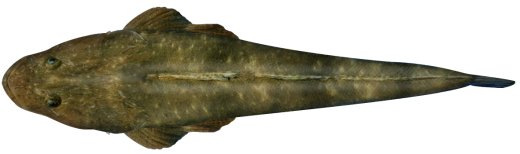
Dusky FlatheadPlatycephalus fuscus
📍 WhereWo
Chambers Island (Pin #2) — sand edges dropping to the channelChambers Island (Pin #2) — Sandkanten, die zum Kanal abfallen
🪱 Bait & LuresKöder & Kunstköder
7–9 cm paddle-tail soft plastic on a 1/8 oz jighead (main). Also whole prawn or live baitfish.7–9 cm Paddeltail-Weichplastik an einem 1/8-oz-Jigkopf (Haupt). Auch ganze Garnele oder lebender Köderfisch.
MainlineHauptschnur10–15 lb braid
LeaderVorfach10–20 lb fluoro, 40–60 cm
HookHaken1/0–2/0 wide gap (bait) or jighead
Lead / sinkerBleiNo.2–No.4 ball for live baitKugelblei Nr.2–4 für Lebendköder
KnotKnotenUni or Palomar to jighead; double uni leaderUni oder Palomar zum Jigkopf; Doppel-Uni-Vorfach
🎣 Reel — slow or wait?Kurbeln — langsam oder warten?
Lure: slow hops, let it tick the bottom every hop, pause 2–3 seconds — most hits come as it sinks. Bait: leave it on the bottom.Kunstköder: langsame Hüpfer, bei jedem Hüpfer den Grund antippen, 2–3 Sekunden Pause — die meisten Bisse kommen beim Absinken. Köder: am Grund liegen lassen.
⏱ How long to wait for the biteWie lange auf den Biss warten
They hit with a hard thump. Wait 1–2 seconds, then lift firmly. On whole or live bait, let it run a couple of seconds first.Sie beißen mit einem harten Schlag. 1–2 Sekunden warten, dann kräftig anheben. Bei ganzem oder lebendem Köder erst ein paar Sekunden laufen lassen.
⚖ QLD rulesQLD-Regeln
Slot 40–75 cm ONLY · Bag 5
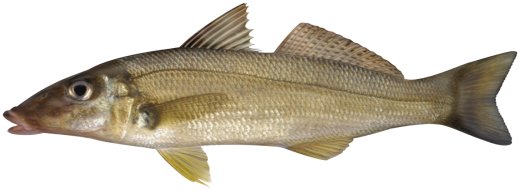
Sand WhitingSillago ciliata
📍 WhereWo
Chambers Island (Pin #2) — flooded sand flats on the incoming tideChambers Island (Pin #2) — überflutete Sandflächen bei auflaufender Tide
🪱 Bait & LuresKöder & Kunstköder
Yabby (best), live beach worm, or half a pipi. Prawn works too.Yabby (am besten), lebender Strandwurm oder eine halbe Pipi. Garnele geht auch.
MainlineHauptschnur4–8 lb mono
LeaderVorfach4–6 lb fluoro, 30 cm
HookHakenSize 6–8 long shank ONLY (tiny mouth)
Lead / sinkerBleiNo.0–No.1 split shot ONLYNur Spaltblei Nr.0–1
KnotKnotenUni knotUni-Knoten
🎣 Reel — slow or wait?Kurbeln — langsam oder warten?
Cast it out and LEAVE it — do not retrieve. A very slow tiny drag over the sand can sometimes help.Auswerfen und LIEGEN lassen — nicht einkurbeln. Ein ganz langsames, kleines Ziehen über den Sand kann manchmal helfen.
⏱ How long to wait for the biteWie lange auf den Biss warten
Whiting peck fast. Ignore the first taps — lift only when the tip pulls down and stays there (2–4 seconds).Whiting picken schnell. Ignoriere die ersten Zupfer — erst anheben, wenn die Spitze nach unten zieht und unten bleibt (2–4 Sekunden).
⚖ QLD rulesQLD-Regeln
Min 23 cm · Bag 30
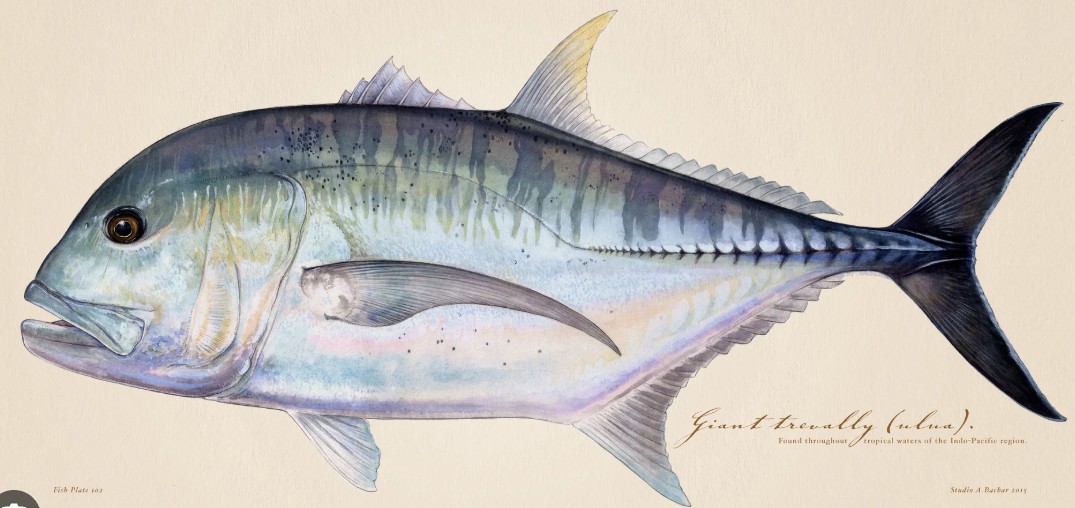
Giant / Yellowfin TrevallyCaranx spp.
📍 WhereWo
Canal entrances (Pin #1) and the river mouth (Pin #3)Kanaleingänge (Pin #1) und Flussmündung (Pin #3)
🪱 Bait & LuresKöder & Kunstköder
Metal slice 15–30 g (main). Also soft plastic 9–12 cm.Metallblinker 15–30 g (Haupt). Auch Weichplastik 9–12 cm.
MainlineHauptschnur15–20 lb braid
LeaderVorfach20–30 lb fluoro
HookHaken2/0–3/0 strong (or lure hooks)
Lead / sinkerBleiNone — lure onlyKeins — nur Kunstköder
KnotKnotenPalomar or uni to the lure; double uni leaderPalomar oder Uni zum Köder; Doppel-Uni-Vorfach
🎣 Reel — slow or wait?Kurbeln — langsam oder warten?
Cast the metal slug and wind FAST and steady — never pause. The hit comes mid-retrieve.Metallblinker auswerfen und SCHNELL und gleichmäßig einkurbeln — niemals pausieren. Der Biss kommt während des Einholens.
⏱ How long to wait for the biteWie lange auf den Biss warten
No waiting — keep winding right through the hit, then lift.Kein Warten — beim Biss einfach weiterkurbeln, dann anheben.
⚖ QLD rulesQLD-Regeln
No min · Bag 5 · release GT over 60 cm
Luderick (Blackfish)Girella tricuspidata
📍 WhereWo
Point Cartwright wall (Pin #3) — where weed grows on the rocksPoint-Cartwright-Mauer (Pin #3) — wo Seegras an den Felsen wächst
🪱 Bait & LuresKöder & Kunstköder
Fresh green cabbage weed picked off the wall — nothing else works.Frisches grünes Seegras von der Mauer — nichts anderes funktioniert.
MainlineHauptschnur6–10 lb MONO (not braid)
LeaderVorfach4–6 lb fluoro, 50–80 cm
HookHakenSize 8–10 long shank
Lead / sinkerBleiPencil float + split shot only — no bomb sinkerStäbchen-Pose + Spaltblei — kein Grundblei
KnotKnotenUni knotUni-Knoten
🎣 Reel — slow or wait?Kurbeln — langsam oder warten?
Float rig: leave the line, just watch the pencil float. Let the weed drift naturally with the current.Posen-Montage: Schnur ruhig lassen, nur die Stäbchen-Pose beobachten. Das Seegras natürlich mit der Strömung treiben lassen.
⏱ How long to wait for the biteWie lange auf den Biss warten
When the float dips fully under, lift straight away — luderick spit the weed fast.Wenn die Pose ganz untertaucht, sofort anheben — Luderick spucken das Seegras schnell aus.
⚖ QLD rulesQLD-Regeln
Min 25 cm · Bag 20
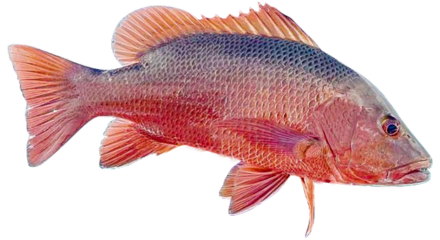
Mangrove JackLutjanus argentimaculatus
📍 WhereWo
Minyama bridge pylons (Pin #1) — after darkMinyama-Brückenpfeiler (Pin #1) — nach Einbruch der Dunkelheit
🪱 Bait & LuresKöder & Kunstköder
Live poddy mullet or live prawn (best). Also hardbody lures.Lebende Meeräsche oder lebende Garnele (am besten). Auch Hardbody-Köder.
MainlineHauptschnur15–20 lb braid
LeaderVorfach30–40 lb fluoro, 50 cm
HookHaken3/0–5/0 strong wire
Lead / sinkerBleiLight running sinker if neededLeichtes Laufblei bei Bedarf
KnotKnotenPalomar (strongest); double uni leaderPalomar (am stärksten); Doppel-Uni-Vorfach
🎣 Reel — slow or wait?Kurbeln — langsam oder warten?
Live bait: leave it near the pylons, drag locked tight, rod in your hand. Lure: steady retrieve tight to the structure.Lebendköder: in der Nähe der Pfeiler lassen, Bremse fest zugedreht, Rute in der Hand. Kunstköder: gleichmäßig dicht an der Struktur einholen.
⏱ How long to wait for the biteWie lange auf den Biss warten
Do NOT wait. The instant it hits, strike hard and pull it away from the structure — or it will cut you off.NICHT warten. Sobald es beißt, kräftig anschlagen und vom Hindernis wegziehen — sonst durchtrennt es die Schnur.
⚖ QLD rulesQLD-Regeln
Min 35 cm · Bag 5
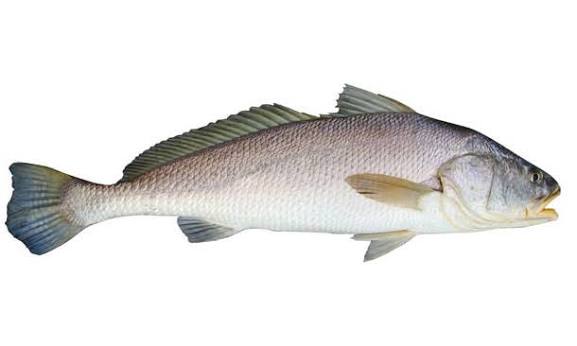
Mulloway / JewfishArgyrosomus japonicus
📍 WhereWo
Point Cartwright western wall (Pin #3) — deep channel, after darkWestmauer Point Cartwright (Pin #3) — tiefer Kanal, nach Einbruch der Dunkelheit
🪱 Bait & LuresKöder & Kunstköder
Fresh whole squid, live yellowtail scad, or large mullet fillet. Change the bait every 30 minutes.Frischer ganzer Tintenfisch, lebende Makrele oder großes Meeräschenfilet. Köder alle 30 Minuten wechseln.
MainlineHauptschnur15–24 lb braid
LeaderVorfach40–60 lb fluoro, 60–80 cm (change each session)
HookHaken4/0–6/0 CIRCLE hook
Lead / sinkerBleiNo.3–No.6 ball running sinkerLaufblei Kugel Nr.3–6
KnotKnotenUni or Palomar to the circle hook; double uni leaderUni oder Palomar zum Kreishaken; Doppel-Uni-Vorfach
🎣 Reel — slow or wait?Kurbeln — langsam oder warten?
Leave the bait still on the bottom. With a circle hook do NOT strike — when the rod loads up, just wind down and lift smoothly.Köder ruhig am Grund liegen lassen. Mit Kreishaken NICHT anschlagen — wenn die Rute sich biegt, einfach herunterkurbeln und sanft anheben.
⏱ How long to wait for the biteWie lange auf den Biss warten
A mulloway take is slow and heavy. Wait until the line pulls tight and stays (5–10 seconds), then lean into it. June is peak month.Ein Mulloway-Biss ist langsam und schwer. Warte, bis die Schnur straff wird und bleibt (5–10 Sekunden), dann ins Gewicht gehen. Juni ist Hauptsaison.
⚖ QLD rulesQLD-Regeln
Min 75 cm · Bag 5 · release over 90 cm
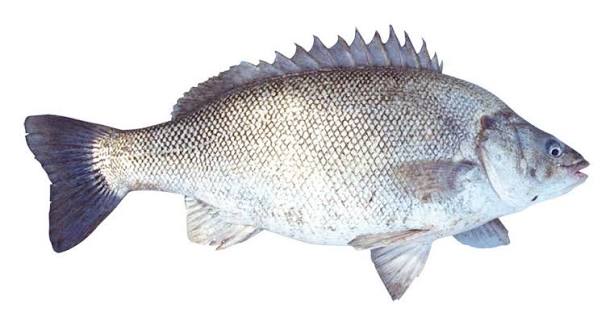
Grunter (Javelin)Pomadasys kaakan
📍 WhereWo
Chambers Island bridge pylons (Pin #2)Chambers-Island-Brückenpfeiler (Pin #2)
🪱 Bait & LuresKöder & Kunstköder
Half a peeled prawn (best). Also a 5 cm mullet strip.Eine halbe geschälte Garnele (am besten). Auch ein 5 cm Meeräschen-Streifen.
MainlineHauptschnur8–12 lb braid
LeaderVorfach8–12 lb fluoro, 40 cm
HookHaken1/0–2/0 wide gap
Lead / sinkerBleiNo.1–No.2 ball running sinkerLaufblei Kugel Nr.1–2
KnotKnotenUni knotUni-Knoten
🎣 Reel — slow or wait?Kurbeln — langsam oder warten?
Cast upstream of the pylon and let the bait drift down alongside it with light tension — don't retrieve fast.Stromaufwärts vom Pfeiler werfen und den Köder mit leichter Spannung daneben heruntertreiben lassen — nicht schnell einholen.
⏱ How long to wait for the biteWie lange auf den Biss warten
Grunter give a strong rattly bite. Let it pull down for 2–3 seconds, then lift.Grunzfische geben einen kräftigen, ruckelnden Biss. 2–3 Sekunden ziehen lassen, dann anheben.
⚖ QLD rulesQLD-Regeln
Min 25 cm · Bag 20
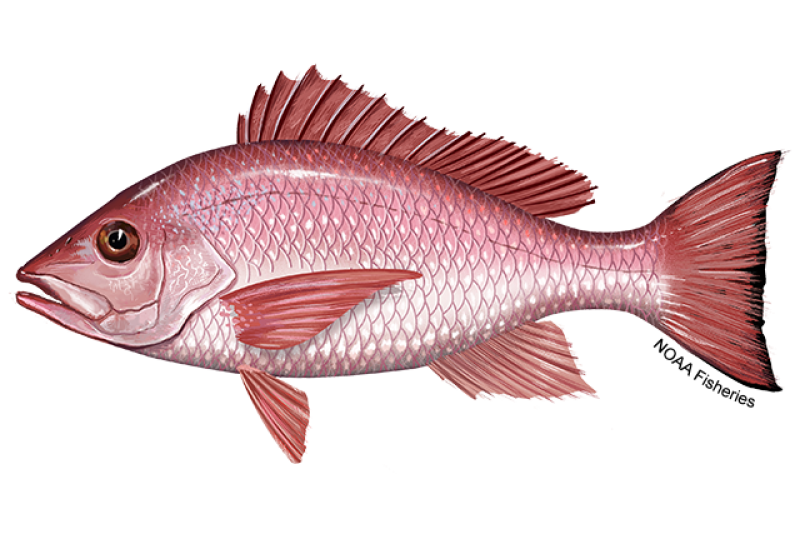
Snapper / SquireChrysophrys auratus
📍 WhereWo
Point Cartwright deep channel (Pin #3) — at nightTiefer Kanal Point Cartwright (Pin #3) — nachts
🪱 Bait & LuresKöder & Kunstköder
Fresh whole squid, fresh pilchard, or whole prawn.Frischer ganzer Tintenfisch, frische Sardine oder ganze Garnele.
MainlineHauptschnur12–20 lb braid
LeaderVorfach20–40 lb fluoro, 50 cm
HookHaken2/0–4/0 CIRCLE hook
Lead / sinkerBleiNo.2–No.4 ball running sinkerLaufblei Kugel Nr.2–4
KnotKnotenUni or Palomar to the circle hookUni oder Palomar zum Kreishaken
🎣 Reel — slow or wait?Kurbeln — langsam oder warten?
Bait on the bottom in the deep channel, left still. Circle hook — wind down when it loads, don't strike.Köder am Grund im tiefen Kanal, ruhig liegen lassen. Kreishaken — herunterkurbeln, wenn er sich biegt, nicht anschlagen.
⏱ How long to wait for the biteWie lange auf den Biss warten
Wait for a knock followed by steady weight (3–5 seconds), then lift into it.Warte auf ein Klopfen, gefolgt von gleichmäßigem Gewicht (3–5 Sekunden), dann hineinheben.
⚖ QLD rulesQLD-Regeln
Min 35 cm · Bag 8 · CLOSED 15 Jul–15 Aug
Knots & RigsKnoten & Montagen
Three knots, three rigs and how to pick your hookDrei Knoten, drei Montagen und die richtige Hakenwahl
Start with these three knotsBeginne mit diesen drei Knoten
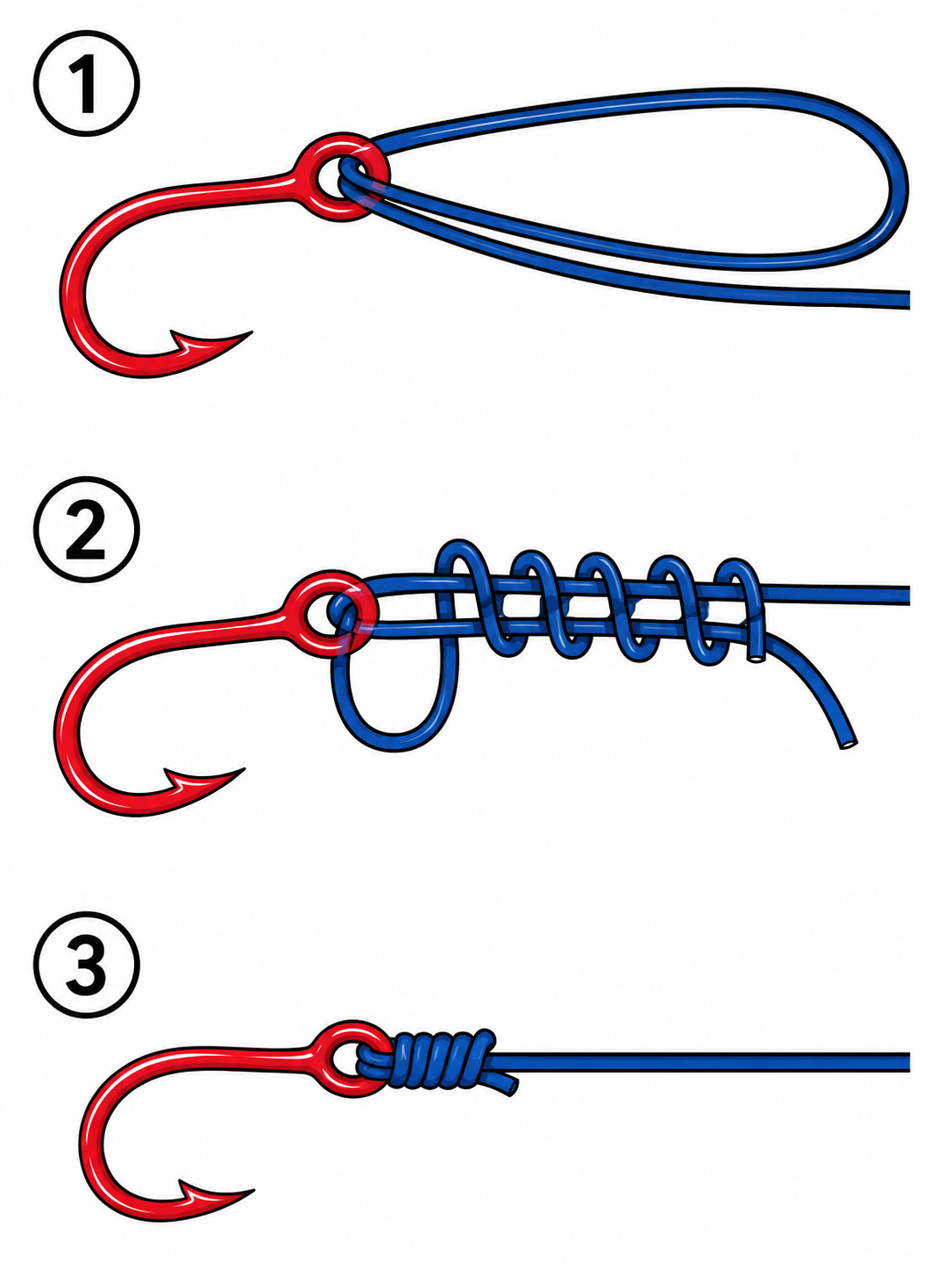
The Uni knot ties almost everything. Use Palomar when you want maximum strength, and Double Uni to join braid to leader.Der Uni-Knoten bindet fast alles. Nimm Palomar für maximale Stärke und Doppel-Uni, um Geflecht mit Vorfach zu verbinden.
Thread the line through the hook eye and double it back to make a loop.Schnur durch das Hakenöhr führen und zurücklegen, sodass eine Schlaufe entsteht.
Wrap the tag end through the loop and around the doubled line 5–6 times.Das lose Ende 5–6 Mal durch die Schlaufe und um die doppelte Schnur wickeln.
Wet it, pull the tag end to tighten the coils, then slide the knot down to the eye.Anfeuchten, am losen Ende ziehen, um die Wicklungen zu schließen, dann den Knoten zum Öhr schieben.
Pull tight and trim the tag end.Festziehen und das lose Ende abschneiden.
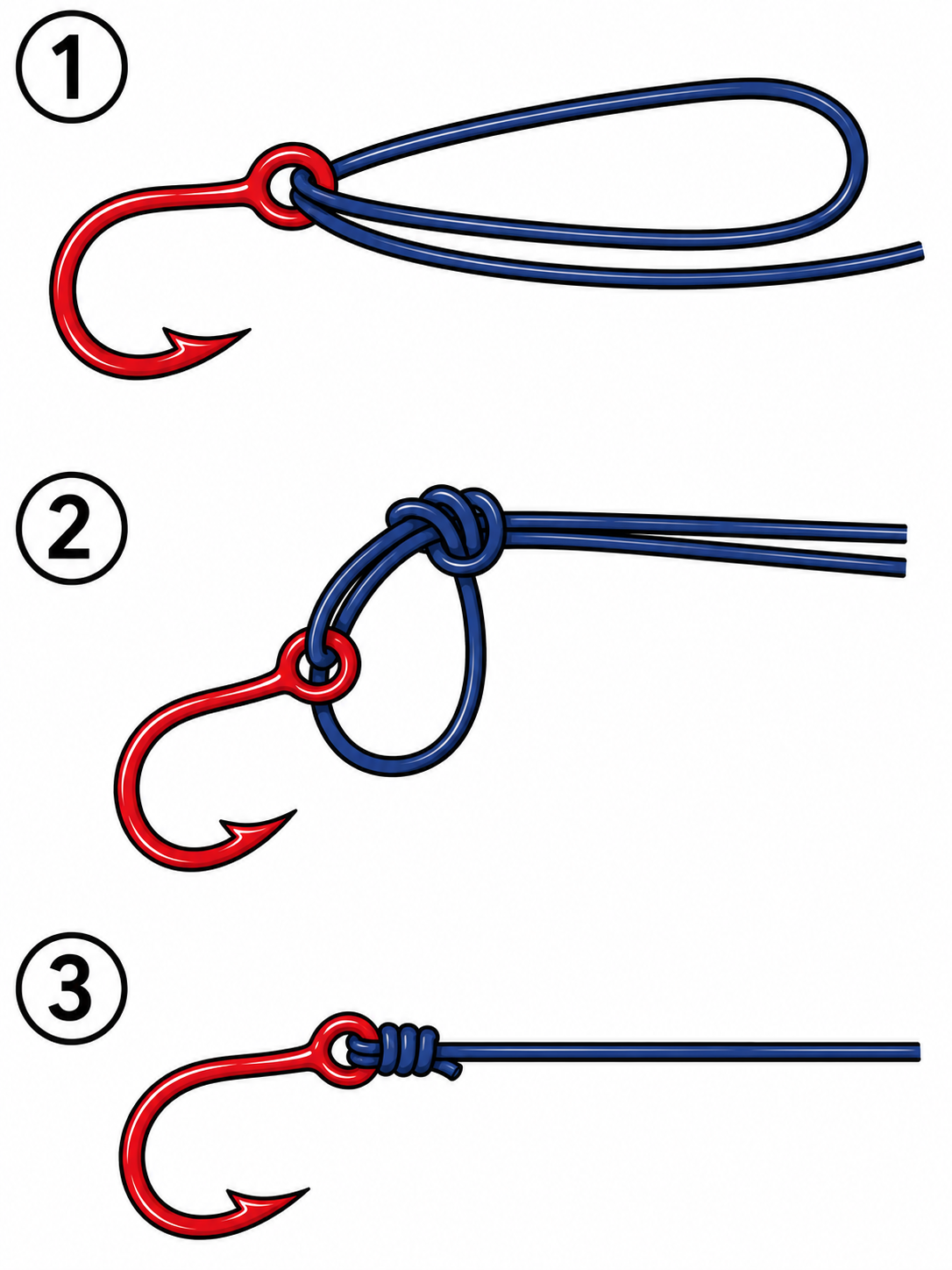
Double about 15 cm of line and pass the loop through the eye.Etwa 15 cm Schnur doppeln und die Schlaufe durch das Öhr führen.
Tie a loose overhand knot with the doubled line — the hook hangs in the middle.Mit der doppelten Schnur einen losen Überhandknoten machen — der Haken hängt in der Mitte.
Pass the loop right over the whole hook.Die Schlaufe komplett über den ganzen Haken führen.
Wet it, pull both ends tight, and trim.Anfeuchten, beide Enden festziehen und abschneiden.
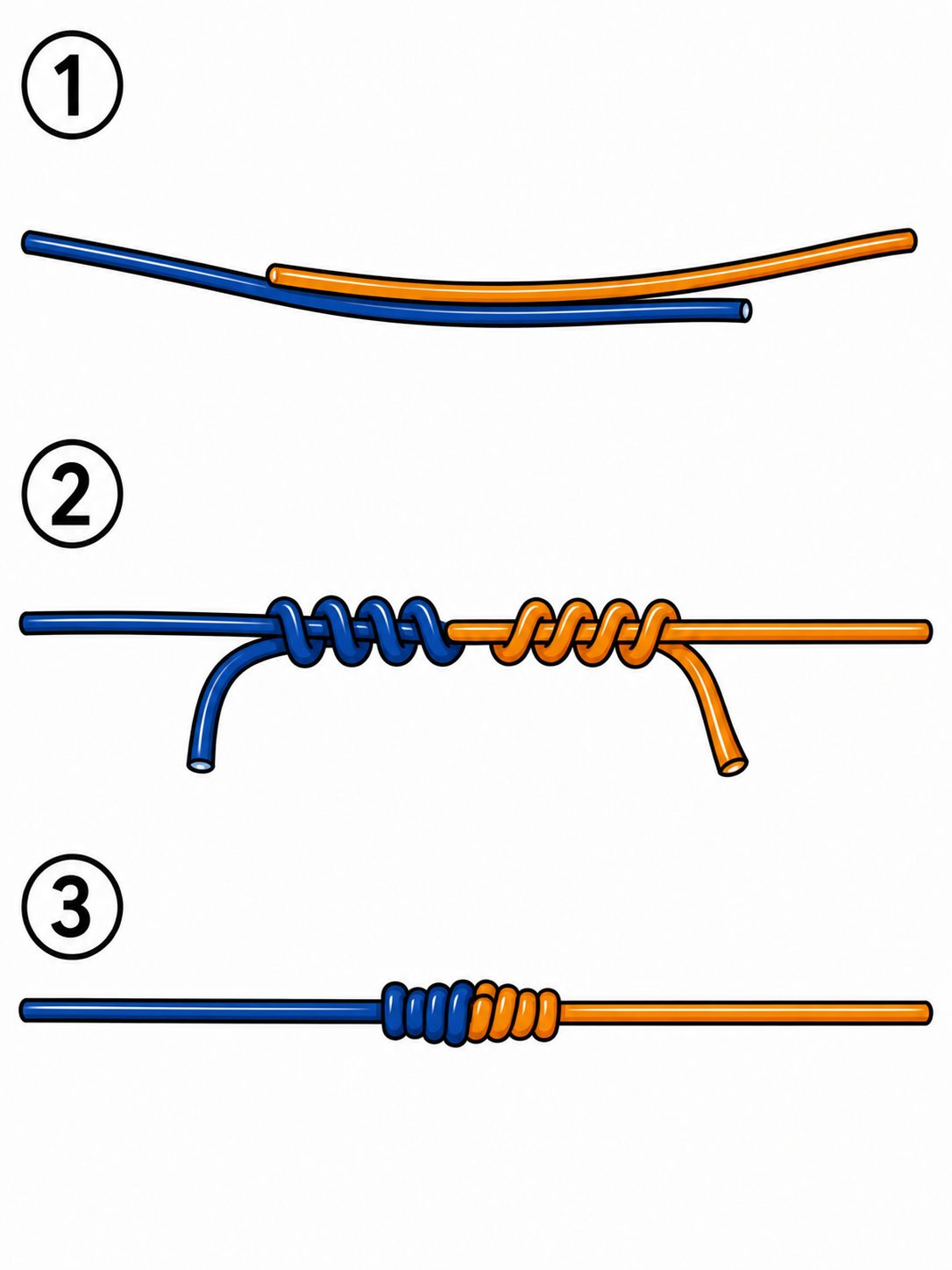
Overlap the two lines by about 15 cm.Die beiden Schnüre etwa 15 cm überlappen lassen.
With one line make a uni knot (5–6 wraps) around the other; then repeat with the other line.Mit einer Schnur einen Uni-Knoten (5–6 Wicklungen) um die andere machen; dann mit der anderen Schnur wiederholen.
Wet both, then pull until the two knots slide together and lock.Beide anfeuchten, dann ziehen, bis die zwei Knoten zusammenrutschen und blockieren.
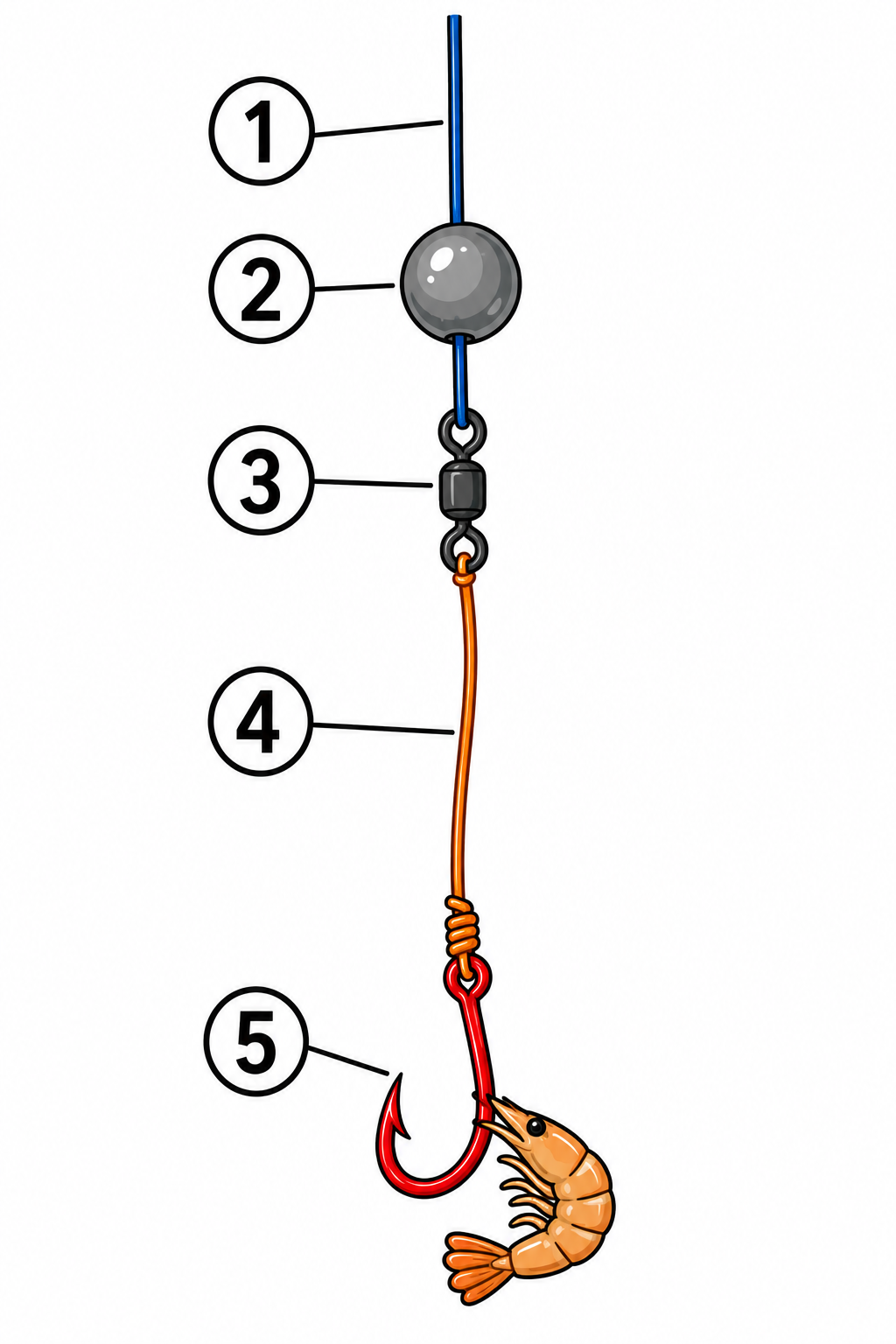
① Thread a ball sinker (the lead) onto your line so it slides freely.① Ein Kugelblei auf die Schnur fädeln, sodass es frei gleitet.
② Tie a small swivel below it with a uni knot — the sinker now rests on the swivel.② Darunter einen kleinen Wirbel mit Uni-Knoten anbinden — das Blei liegt nun auf dem Wirbel auf.
③ Tie 30–60 cm of leader from the swivel to ④ the hook and bait.③ 30–60 cm Vorfach vom Wirbel zu ④ Haken und Köder anbinden.
Why: the sinker slides on the line, so a fish feels no weight when it takes the bait. For whiting / light fishing, skip the ball sinker and just pinch on 1–2 split shot.Warum: Das Blei gleitet auf der Schnur, sodass der Fisch beim Anbiss kein Gewicht spürt. Für Whiting / leichtes Angeln das Kugelblei weglassen und nur 1–2 Spaltbleie anklemmen.
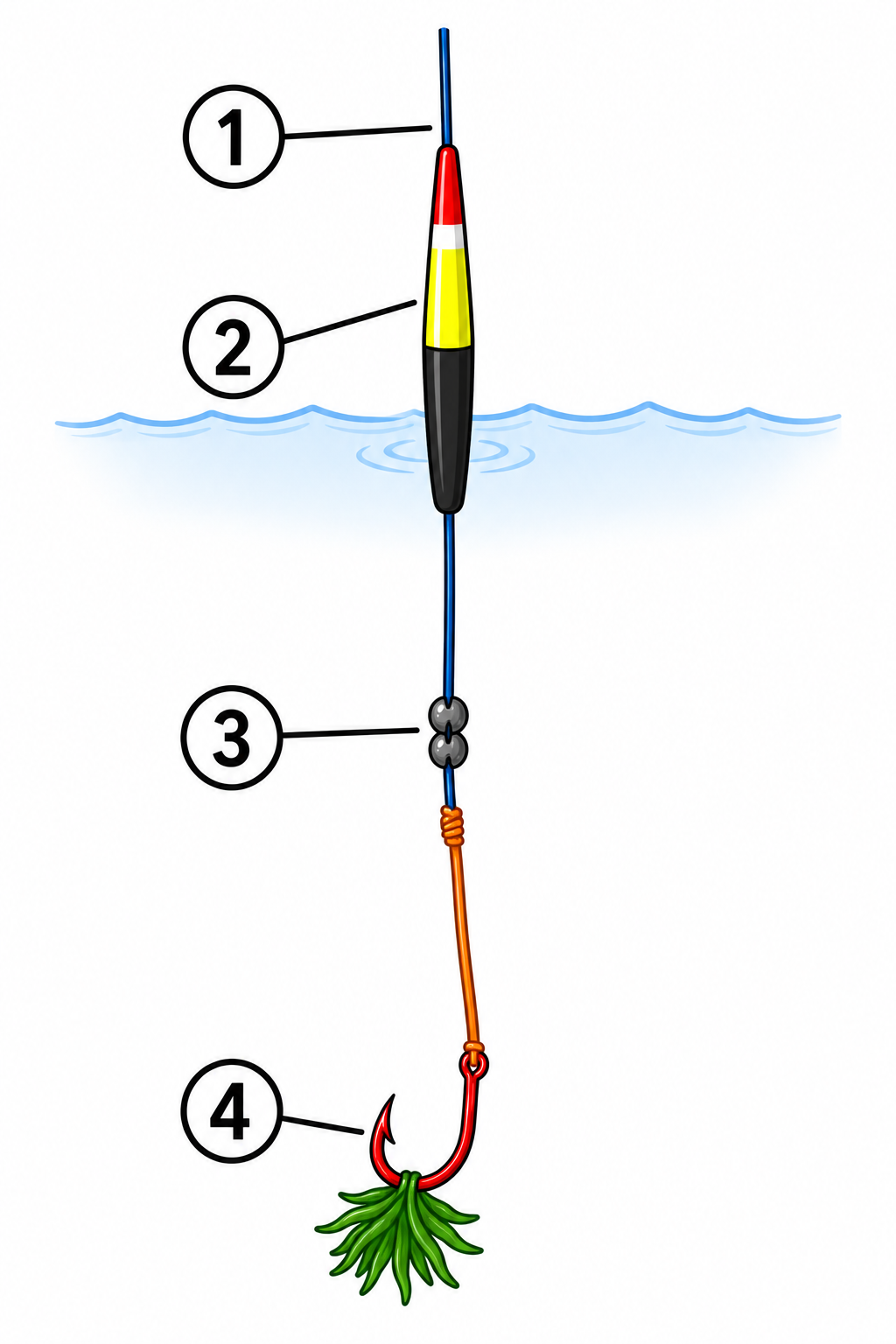
① Slide a pencil float onto the mono mainline.① Eine Stäbchen-Pose auf die Mono-Hauptschnur schieben.
② Pinch 1–2 split shot below the float so just the tip shows above water.② 1–2 Spaltbleie unter der Pose anklemmen, sodass nur die Spitze aus dem Wasser ragt.
③ Tie on a small long-shank hook and load it with fresh green weed.③ Einen kleinen Langschenkelhaken anbinden und mit frischem grünem Seegras bestücken.
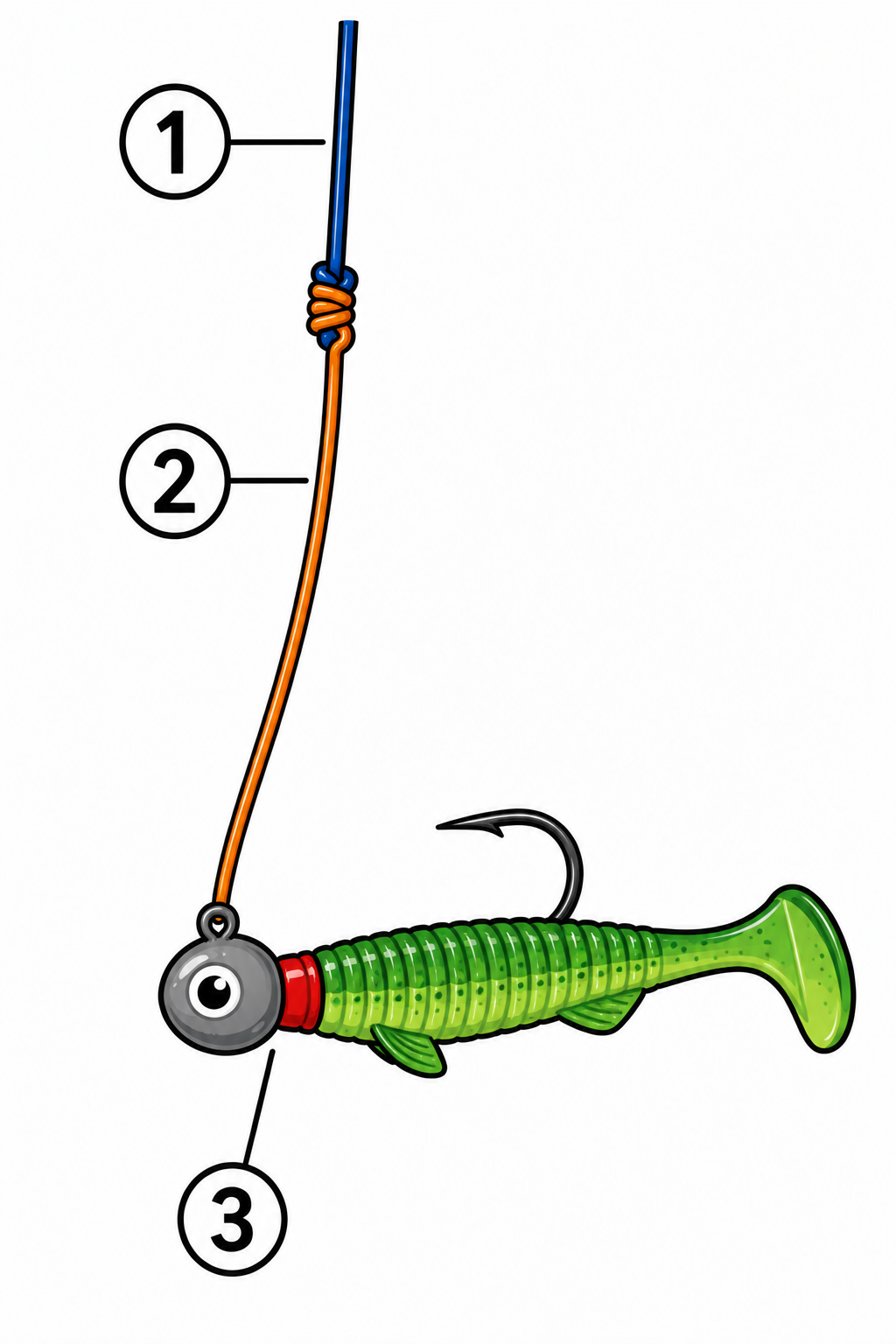
① Join braid mainline to ② a fluoro leader with a double uni knot.① Geflecht-Hauptschnur mit ② einem Fluo-Vorfach per Doppel-Uni verbinden.
② Tie the leader to a weighted jighead (uni or Palomar).② Das Vorfach an einen beschwerten Jigkopf anbinden (Uni oder Palomar).
③ Thread the soft plastic straight onto the jighead so it sits flat.③ Das Weichplastik gerade auf den Jigkopf ziehen, sodass es flach sitzt.
Choosing your hookDen Haken wählen
📏 Long shank hookLangschenkelhaken
A long straight shank. Best for small-mouthed fish and threaded baits — whiting, garfish, worm and pipi. Easy to unhook, keeps fingers clear of teeth, and stops small fish swallowing it. Use size 6–8 long shank for whiting, 8–10 for luderick.Ein langer gerader Schenkel. Am besten für kleinmäulige Fische und aufgezogene Köder — Whiting, Hornhecht, Wurm und Pipi. Leicht zu lösen, hält die Finger von den Zähnen fern und verhindert, dass kleine Fische ihn schlucken. Größe 6–8 Langschenkel für Whiting, 8–10 für Luderick.
🪝 Normal / short shank hookNormal- / Kurzschenkelhaken
Compact hooks (octopus, wide-gap, circle). Best for bigger mouths and chunky baits or lures — bream, flathead, grunter, jack, snapper, mulloway. The short shank hides in the bait and holds better. Octopus 1–2 for bream; wide-gap 1/0–2/0 for flathead & grunter; circle 2/0–6/0 for snapper & mulloway.Kompakte Haken (Octopus, Weitspalt, Kreis). Am besten für größere Mäuler und dicke Köder oder Kunstköder — Brasse, Plattkopf, Grunzfisch, Jack, Schnapper, Mulloway. Der kurze Schenkel versteckt sich im Köder und hält besser. Octopus 1–2 für Brasse; Weitspalt 1/0–2/0 für Plattkopf & Grunzfisch; Kreis 2/0–6/0 für Schnapper & Mulloway.
Rule of thumb: small mouth or a threaded worm/pipi → long shank. Big mouth or chunky bait/lure → normal short shank. With circle hooks (snapper, mulloway) don't strike — let the rod load up and just lift.Faustregel: kleines Maul oder aufgezogener Wurm/Pipi → Langschenkel. Großes Maul oder dicker Köder/Kunstköder → normaler Kurzschenkel. Bei Kreishaken (Schnapper, Mulloway) nicht anschlagen — die Rute sich biegen lassen und nur anheben.
Bait & LuresKöder & Kunstköder
Your lure box, plus free bait you can catch around MooloolabaDeine Köderbox, plus Gratisköder rund um Mooloolaba
Your lure box (artificial baits)Deine Köderbox (Kunstköder)
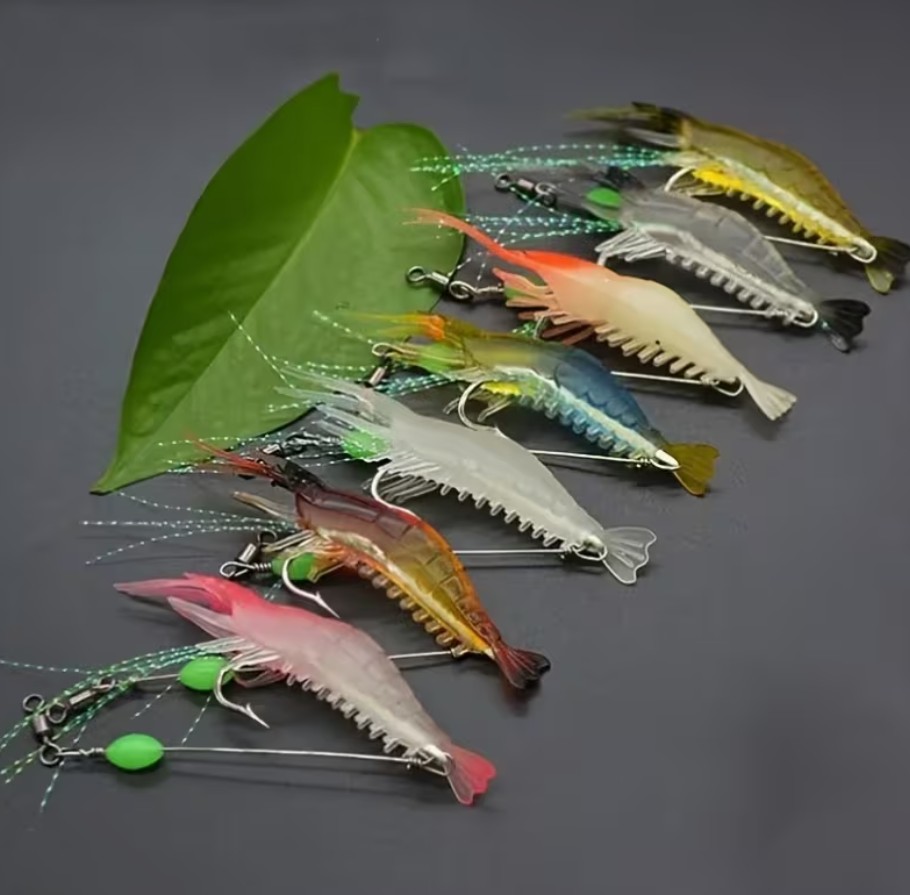
The best match for the local prawn diet. Cast near structure and do a slow lift-and-drop along the bottom — the glow shines at dawn, dusk and night.Passt am besten zur lokalen Garnelen-Nahrung. Nahe der Struktur werfen und langsam am Grund heben und senken — das Leuchten wirkt bei Morgen-, Abenddämmerung und nachts.
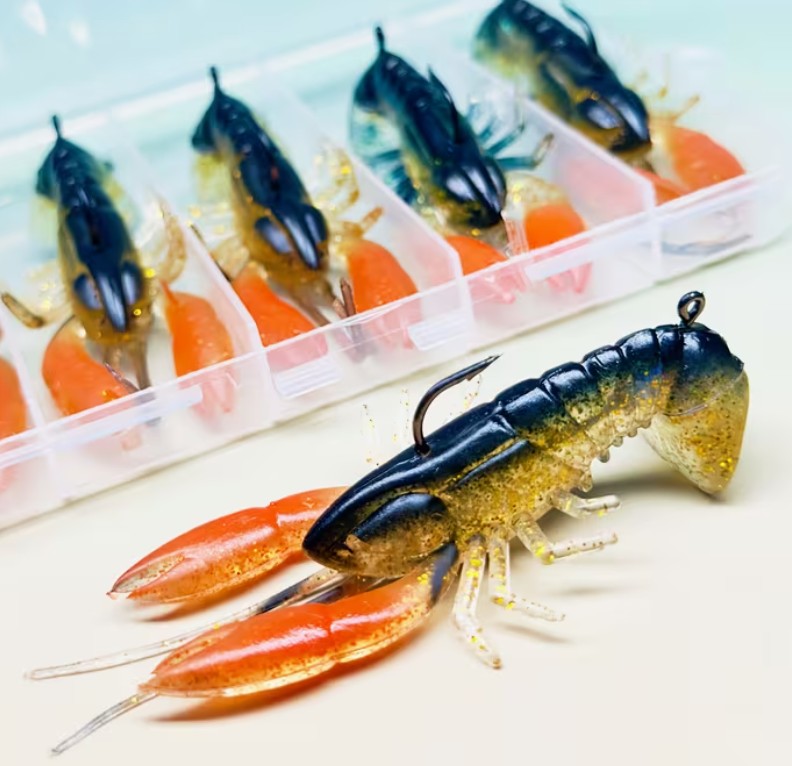
Soft Crayfish / YabbyWeich-FlusskrebsAround structureAn der Struktur
Hop it slowly along the bottom tight to bridge pylons and rock walls, pausing often. Deadly near snags.Langsam am Grund dicht an Brückenpfeilern und Felsmauern hüpfen lassen, oft pausieren. Tödlich nahe Hindernissen.
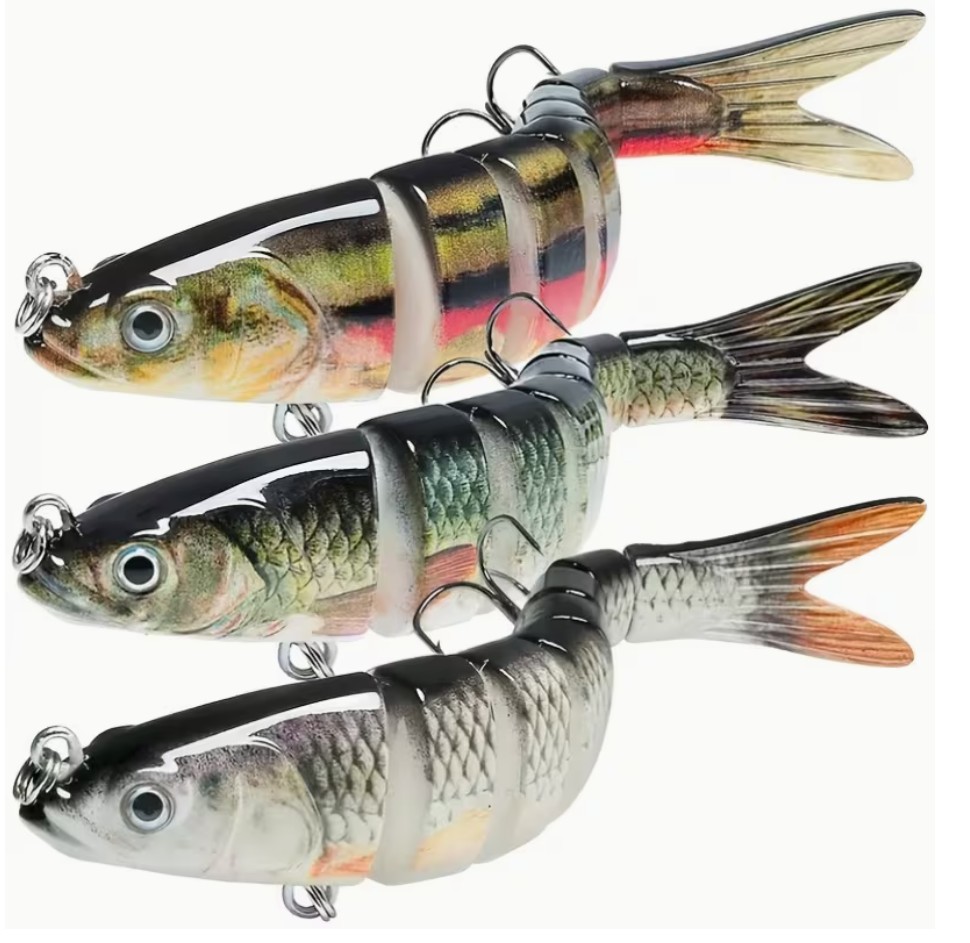
Cast out and wind slow and steady so it swims with a lifelike wobble; pause near drop-offs. Swap rusty trebles (see hooks below).Auswerfen und langsam, gleichmäßig einkurbeln, damit er lebensecht schlängelt; an Kanten pausieren. Verrostete Drillinge tauschen (siehe Haken unten).
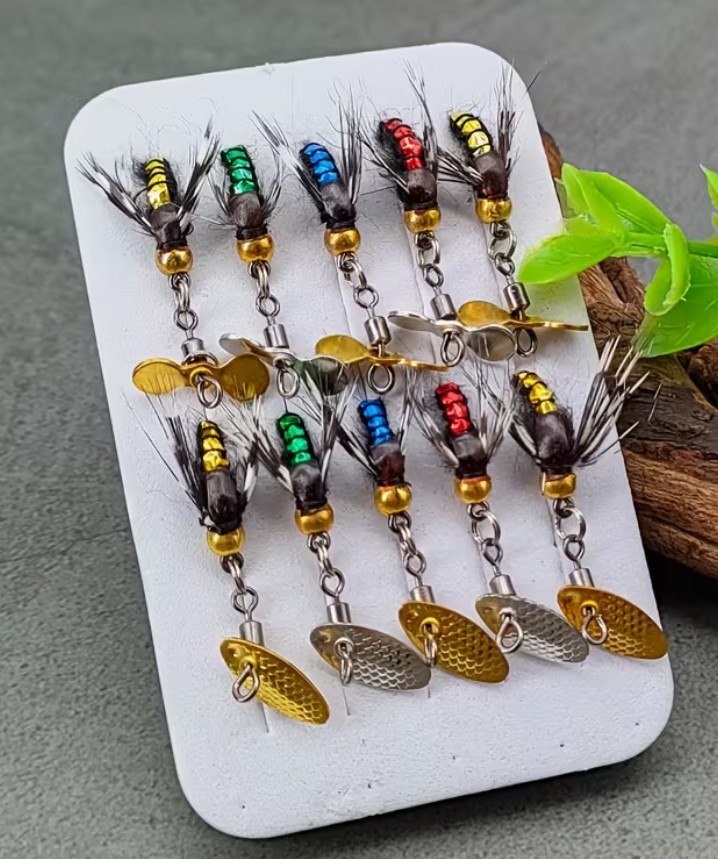
Flash Spinner FliesSpinner-FliegenFlash in currentBlitz in der Strömung
Small blade lure — cast and retrieve steadily so the blade spins. The flash pulls strikes in moving water at canal entrances and the river mouth.Kleiner Blattköder — werfen und gleichmäßig einholen, damit das Blatt rotiert. Der Blitz lockt Bisse im strömenden Wasser an Kanaleingängen und der Flussmündung.
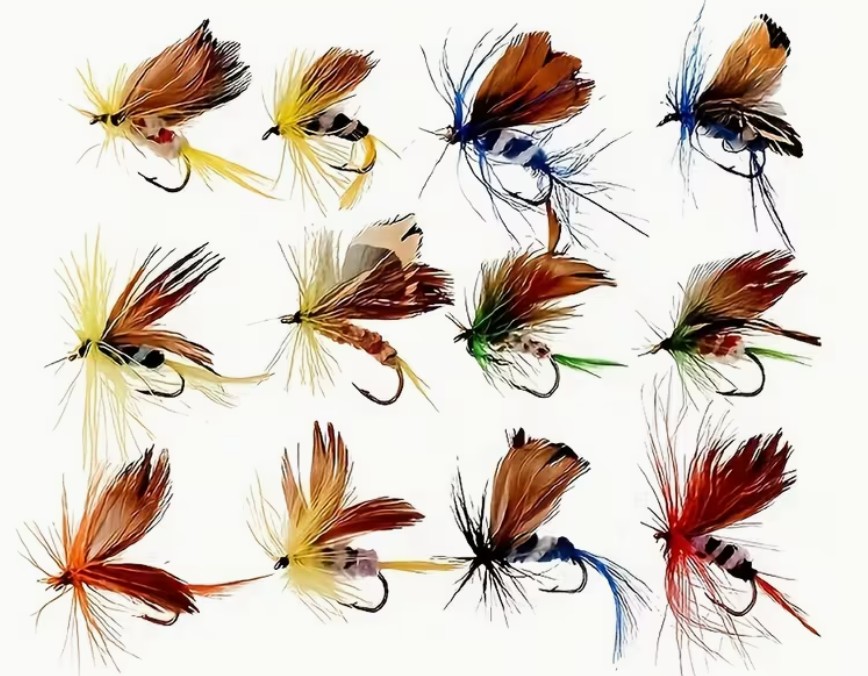
🎯 Garfish · small surface feedersHornhecht · kleine Oberflächenfische
Tiny insect flies for fun on very light line near the surface — twitch slowly. The least useful of your kit for the big estuary species.Winzige Insektenfliegen zum Spaß an sehr leichter Schnur nahe der Oberfläche — langsam zupfen. Am wenigsten nützlich für die großen Ästuar-Arten.
🎯 Upgrades the swimbaits & metal slugsRüstet Schwimmköder & Metallblinker auf
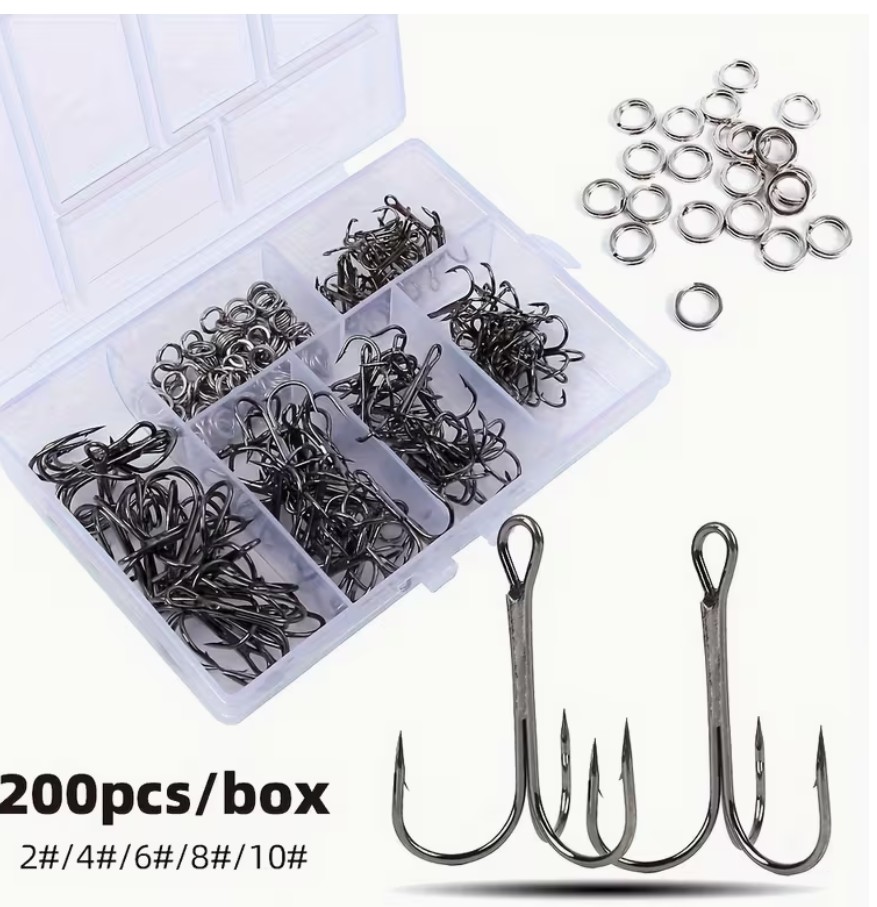
Swap rusty or bent trebles with split-ring pliers. Sizes 2–10: larger (2–4) for swimbaits & mulloway lures, smaller (6–10) for light lures.Verrostete oder verbogene Drillinge mit einer Sprengringzange tauschen. Größen 2–10: größer (2–4) für Schwimmköder & Mulloway-Köder, kleiner (6–10) für leichte Köder.
Catch your own baitEigenen Köder fangen
🦪 Pipi (sand clam)Pipi (Sandmuschel)
The Pipi Shuffle: stand at the water's edge on Mooloolaba or Maroochydore Beach and shuffle your feet side-to-side into the wet sand. Feel for hard oval shells underfoot and dig with your hands — they cluster together. Best around low tide (±1 hr).Der Pipi-Shuffle: am Wasserrand am Mooloolaba- oder Maroochydore-Strand stehen und die Füße seitlich in den nassen Sand schieben. Mit den Füßen nach harten ovalen Muscheln tasten und mit den Händen graben — sie sitzen in Gruppen. Am besten um Niedrigwasser (±1 Std.).
Limit 50 / personLimit 50 / Person
Best for whiting & breamTop für Whiting & Brasse
🦑 Squid (calamari)Tintenfisch (Calamari)
Jig at Point Cartwright rock wall or the boat ramp, dusk to 9 pm (darker nights are better). Use an egi jig size 2.5–3.5 — pink/orange in clear water, glow on dark nights. Cast near structure, let it sink, then a slow rhythmic lift-and-drop. Limit 20 / person. Fresh squid is premium bait for mulloway, snapper and flathead.An der Felsmauer Point Cartwright oder an der Bootsrampe jiggen, von der Dämmerung bis 21 Uhr (dunklere Nächte sind besser). Egi-Jig Größe 2,5–3,5 verwenden — rosa/orange im klaren Wasser, leuchtend in dunklen Nächten. Nahe der Struktur werfen, absinken lassen, dann langsames rhythmisches Heben und Senken. Limit 20 / Person. Frischer Tintenfisch ist Top-Köder für Mulloway, Schnapper und Plattkopf.
Set a crab pot or dilly net baited with a chicken frame or fish head in the upper reaches of Chambers Island / Maroochy River mangrove edges. Best on the incoming tide to high water, when crabs move and feed.Einen Krabbenkorb oder ein Senknetz mit Hühnergerüst oder Fischkopf in den oberen Bereichen von Chambers Island / an den Mangrovenrändern des Maroochy River auslegen. Am besten bei auflaufender Tide bis Hochwasser, wenn die Krabben aktiv sind und fressen.
Min 15 cm carapace · 7 per person / 14 per boat · release ALL females (broad rounded flap).Min. 15 cm Panzer · 7 pro Person / 14 pro Boot · ALLE Weibchen freilassen (breite runde Bauchklappe).
Land-based spots across the coast — what to target and whenLandgebundene Stellen entlang der Küste — worauf und wann
Maroochy RiverMaroochy River
📍 Maroochy mouth — Cotton Tree & Pincushion Is.Maroochy-Mündung — Cotton Tree & Pincushion Is.
FlatheadWhitingBreamTrevally
Sand flats and deep holes from the Cod Hole down to the mouth. Best on the run-in over the flats; bream & trevally around the river-mouth rock walls.Sandflächen und tiefe Löcher vom Cod Hole bis zur Mündung. Am besten auflaufend über die Flächen; Brasse & Stachelmakrele an den Mauern der Flussmündung.
📍 Chambers Island (Pin #2)Chambers Island (Pin #2)
FlatheadWhitingGrunterBreamMud Crab
Soft plastics on the sand edges; yabby on the flats; crab pots in the upper mangroves on the bigger tides.Weichplastik an den Sandkanten; Yabby auf den Flächen; Krabbenkörbe in den oberen Mangroven bei größeren Tiden.
Jetties, pontoons and bridges full of structure — thumping bream and jacks on the tide turns at the light changes (dawn & dusk).Stege, Pontons und Brücken voller Struktur — kräftige Brassen und Jacks bei Tidenwechsel zur Dämmerung.
Sheltered from the wind. Prawn along the pontoons; metal slice at the canal entrances for trevally; squid on the weed at dusk.Windgeschützt. Garnele entlang der Pontons; Metallblinker an den Kanaleingängen für Stachelmakrele; Tintenfisch am Seegras zur Dämmerung.
📍 Point Cartwright wall (Pin #3)Point-Cartwright-Mauer (Pin #3)
BreamLuderickTailorMullowaySnapperSquid
The all-rounder at dusk. Prawn on the shadow line, weed for luderick, whole squid for mulloway after dark.Der Allrounder zur Dämmerung. Garnele an der Schattenlinie, Seegras für Luderick, ganzer Tintenfisch für Mulloway nach Einbruch der Dunkelheit.
⚠ In SE winds fish the inner / sheltered side only.⚠ Bei SO-Wind nur die innere / geschützte Seite befischen.
The shallow passage between the mainland and Bribie. Land-based off the foreshore and the bar rocks; squid on a high tide at night.Der flache Kanal zwischen Festland und Bribie. Landgebunden vom Ufer und den Felsen an der Barre; Tintenfisch bei Hochwasser nachts.
Rock-based tailor and bream; big squid off the rocks in calm conditions. Take care on the ledges.Felsbasierte Tailor und Brassen; große Tintenfische von den Felsen bei ruhigen Bedingungen. Vorsicht auf den Felsplatten.
SEQ's best all-round estuary. Whiting on poppers along Gympie Tce & the Frying Pan, trevally at Munna Point bridge, jacks & trevally in Woods Bay, squid on the weed beds, mud crab up-river.SEQs bestes Allround-Ästuar. Whiting auf Poppern entlang Gympie Tce & der „Frying Pan", Stachelmakrele an der Munna-Point-Brücke, Jacks & Stachelmakrele in Woods Bay, Tintenfisch an den Seegrasbänken, Schlammkrabbe flussaufwärts.
Open surf gutters for tailor (filling in winter) and dart. The same high-energy beaches are the best spots to gather pipi around the low spring tides — see "Best harvest days this month" on the home screen.Offene Brandungsrinnen für Tailor (füllen sich im Winter) und Dart. Dieselben energiereichen Strände sind die besten Stellen für Pipi um die niedrigen Springtiden — siehe „Beste Erntetage diesen Monat" auf der Startseite.
Spots compiled from Sunshine Coast fishing reports, angler forums and local guides — see notes/harvest-and-locations.md. Conditions change; always check local rules & safety.Stellen zusammengestellt aus Sunshine-Coast-Angelberichten, Foren und lokalen Guides. Bedingungen ändern sich; lokale Regeln & Sicherheit stets prüfen.
Guidance only — always confirm current QLD size & bag limits and conditions before you fish.Nur als Orientierung — aktuelle QLD-Maß- & Fangmengen-Limits und Bedingungen vor dem Angeln stets selbst prüfen.